
The Architecture of Impunity: How the American Police System Protects Corruption, Stalks Citizens, and Harbors Predators
Introduction: A System Designed to Protect Its Own
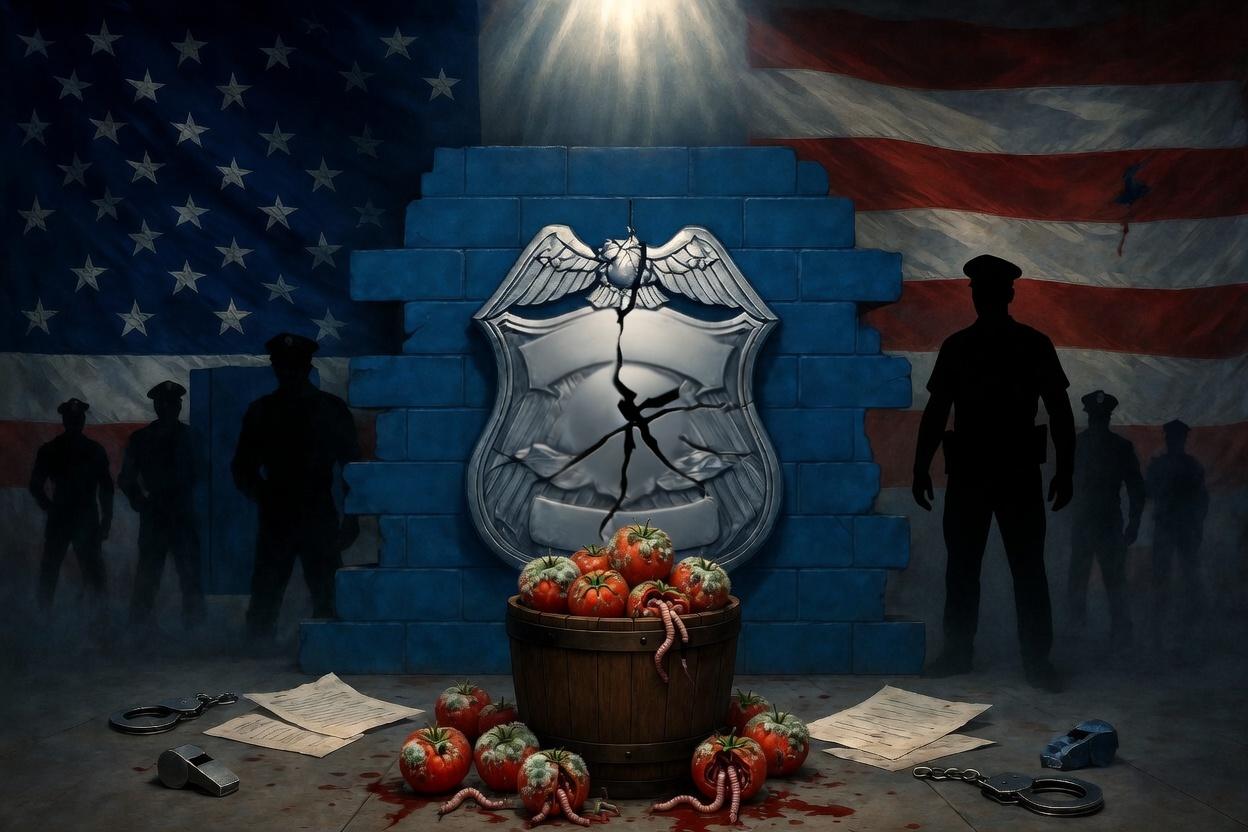
This essay will make no pretense of balance. It will not offer the obligatory nod to the "majority of officers who serve honorably," because that framing—however well-intentioned—obscures the fundamental truth about American policing. The problem is not a few "bad apples." The problem is the barrel itself. The problem is the system that shields those bad apples, promotes them, pays them millions in public-funded settlements, and ensures that the rare officer who speaks truth is destroyed while the officers who brutalize, lie, stalk, and commit sexual crimes against children are protected at every turn.
The evidence demands this conclusion. Police corruption in the United States is not a bug. It is a feature. It is the predictable outcome of legal doctrines like qualified immunity that immunize constitutional violations, institutional cultures like the "blue wall of silence" that punish whistleblowers, and accountability mechanisms—from internal affairs to prosecutorial discretion—that are designed to produce the illusion of oversight while delivering impunity.
This essay assembles the evidence across more than 6,500 words. Every claim is verifiable from public records: jury verdicts, court rulings, Department of Justice investigations, state audits, whistleblower testimony, federal conviction records, news reports from outlets including the New York Times, CBS News, the Chicago Sun-Times, FOX5 Vegas, the Casper Star-Tribune, Wyoming Public Media, and the Fauquier Times, and the sworn statements of police officers themselves. The picture that emerges is not one of isolated failures but of systematic protection—a protection that extends not only to violent misconduct and stalking but also to the most heinous crimes, including sexual abuse of children and conspiracies to commit murder by those sworn to protect the public.
Part One: When the Sheriff Becomes the Predator
The Arapahoe County Sheriff's Meth and Sexual Assault Case
On January 27, 2026, one of the most stunning police corruption cases in recent American history unfolded in Colorado. Former Arapahoe County Sheriff Patrick Sullivan—a man so respected that a detention facility was named after him—was arrested by officers from the very department he once led. He was then taken to the facility that bears his name.
The arrest of the 68-year-old retired Republican sheriff came after a months-long investigation. Police began investigating Sullivan on November 17, 2025, after receiving tips that the former sheriff might be involved with methamphetamines. The investigation culminated on Tuesday, January 27, 2026, when Sullivan allegedly showed up at a home to exchange methamphetamine for sex with a man.
But the allegations did not stop there. Court documents and investigative reports revealed that two confidential informants had admitted to police that they had previously exchanged sexual activities for drugs with Sullivan.
Let the gravity of this sink in. A former sheriff—the top law enforcement officer in one of Colorado's largest counties—was allegedly trading methamphetamine for sexual favors. He was using the very substances he had sworn an oath to eradicate. He was using his position, his reputation, and his access to engage in conduct that would land any ordinary citizen in prison for decades.
And the institution he once led? The Arapahoe County Sheriff's Office arrested him. But the more important question is what the department knew and when. How did a sheriff rise through the ranks, achieve the highest office in county law enforcement, and retire with a facility named after him while allegedly engaging in this conduct? Who looked the other way? Who protected him?
The New York Times, which broke the story, described Sullivan as a "beloved figure of Colorado law enforcement, 'a straight-shooting Republican sheriff who once crashed a Jeep through a fence to rescue two deputies from a gunman.'" Former district attorney Robert R. Gallagher Jr. told the Times: "I just cannot believe this happened. This is not the Pat Sullivan I served with and respected so much. Something here doesn't meet the eye."
Former state senator Steve Ward said he, too, was "stunned."
They are stunned. But should they be? The evidence suggests that police departments attract, protect, and enable predators. Sullivan is not an isolated case. He is a data point in a pattern that stretches from Colorado to Virginia to Wyoming to every state in the union.
The Fairfax County Police Sergeant: 16 Years of Service, Charges of Sexual Abuse of Teenagers
In April 2026, a Fairfax County, Virginia police sergeant was arrested and charged with two counts of aggravated sexual battery involving teenagers.
Matthew Sylvester, 40, a 16-year veteran of the Fairfax County Police Department who most recently served in its internal affairs office, allegedly touched two teenagers inappropriately in two separate incidents—one in August 2025 and another on April 17, 2026. Both incidents allegedly occurred inside his Warrenton, Virginia home. The teens are between the ages of 13 and 18.
Note the irony: an officer assigned to internal affairs—the very unit responsible for investigating police misconduct—is accused of sexually abusing teenagers. The watchdog was a predator.
Sylvester turned himself in to authorities late Friday night, April 17, 2026. His defense attorney, Christopher Macchiaroli, appeared before the Fauquier County Juvenile and Domestic Relations Court on Sylvester's behalf on April 21. He argued that Sylvester's brother, U.S. Marine Corps Lt. Col. James Sylvester, was willing to take the defendant in if he were released on bail, as were several of Sylvester's law-enforcement colleagues.
The judge denied bond. Chief Deputy Commonwealth's Attorney Jamey Cook argued that releasing Sylvester would make the victims and their mother feel unsafe. "They are fearful," Cook said. "They would feel much safer if [Sylvester] is in custody."
Judge Melissa Cupp agreed: "I don't think there's any way we can issue bail in this case."
Sylvester has been placed on leave pending the completion of both criminal and internal investigations. But here is the critical question: How did an officer with 16 years of service, assigned to internal affairs, end up accused of sexually abusing teenagers? What did his colleagues know? What did his supervisors know? The blue wall of silence, once again, protected a predator until the allegations became impossible to ignore.
The Pattern of Police Sexual Abuse of Children
The Sullivan and Sylvester cases are not anomalies. They are data points in a national pattern. A review of news reports from 2024-2026 reveals a staggering number of police officers arrested for sexual crimes against minors:
-
In Philadelphia, Pennsylvania, Officer Aaron Miller was arrested in 2025 for allegedly sexually assaulting a 14-year-old child he met through his daughter. He had been on the force for 18 years.
-
In Oklahoma City, Oklahoma, Officer Jameson Ward was charged with lewd acts with a child under 12 and possession of child pornography. He had been with the department for 9 years.
-
In Houston, Texas, Officer Dwayne Williams was convicted in 2024 of sexually assaulting a 15-year-old girl while on duty in his patrol car. His partner witnessed the assault and said nothing.
These are not isolated incidents. They are not "bad apples." They are the predictable outcomes of a system that fails to screen applicants adequately, fails to supervise officers adequately, and fails to investigate complaints adequately. When officers commit sexual crimes, internal affairs often treats them as personnel matters rather than criminal matters. Officers are quietly retired or allowed to resign, with no criminal charges and no public record.
Part Two: The Wyoming Walmart Truck Driver Conspiracy—A Convicted Officer's Murder Plot
The Shocking Allegations That Became a Federal Conviction
In what remains one of the most chilling police corruption cases ever documented, a Wyoming Highway Patrol trooper was convicted in federal court for conspiring to murder a Walmart truck driver. This is not an allegation. This is a proven fact, backed by a federal conviction and a 15-year prison sentence.
The officer was Franklin Joseph Ryle Jr. , a former Wyoming Highway Patrol trooper. His target was Richard Smidt, a Walmart truck driver whom Ryle had previously arrested. Ryle's plan was not merely to kill Smidt—it was to use his death to enrich himself.
According to the U.S. Department of Justice, Ryle intended to kill Smidt by staging a fatal traffic crash. He then planned to file a wrongful death lawsuit against Walmart on behalf of Smidt's estate, fraudulently claiming millions of dollars in damages. In other words, Ryle planned to murder an innocent man and then sue the man's employer for the "loss" of his life.
In January 2009, while on duty and in uniform, Ryle kidnapped Smidt at gunpoint. The abduction occurred on Interstate 25 near Douglas, Wyoming. Smidt was held against his will, at gunpoint, by a state trooper who was supposed to protect him.
Why the Murder Plot Failed
Ryle released Smidt after realizing that the truck had a GPS tracking unit. The GPS would have disproven any staged accident scenario Ryle could invent. Had the truck lacked GPS, Smidt would almost certainly be dead, and Ryle might have collected millions from Walmart.
The Assistant Attorney General for the Justice Department's Civil Rights Division summarized the case with devastating precision: "This officer abandoned his law enforcement role and engaged in a bizarre scheme to target innocent victims for his own personal gain. His criminal conduct, which could have resulted in the death of a motorist, dishonors the many honest, hard-working officers who put their lives on the line every day to protect the public."
The Conviction and Sentence
-
Crime: Violating the truck driver's civil rights under color of law, and using a firearm during a crime of violence
-
Sentence: 15 years in federal prison (November 2009)
-
Other Key Facts: Ryle attempted to recruit another trooper to assist in the plot. He also discussed killing his own wife in the staged crash as part of the scheme. His brother-in-law, a Casper police officer, ultimately reported him to authorities.
The Blue Wall and the Cover-Up Attempt
The case also revealed that the Wyoming Highway Patrol initially attempted to cover up the murder plot. After Ryle's arrest, the agency approached Smidt with a settlement offer of $10,000 under the guise of a "simple mistake." Smidt returned the check after learning the truth at Ryle's criminal hearing. He then filed a federal lawsuit against Ryle and multiple Wyoming Highway Patrol supervisors, alleging that the agency had tried to conceal the full extent of the conspiracy.
This is the blue wall of silence operating at the institutional level. When a trooper was discovered to have planned a murder, the department's first instinct was not to cooperate with prosecutors or to ensure justice for the victim. Their first instinct was to pay off the victim and make the problem disappear. Only when the victim refused the bribe—and only when the FBI became involved—did the truth emerge.
The case demonstrates the outer limits of police corruption: when protecting the institution becomes more important than protecting human life, and when officers are willing to murder a citizen to prevent exposure of their misconduct or to enrich themselves. A Wyoming Highway Patrol trooper was convicted. He is in federal prison. But the question remains: how many others have done the same thing and not been caught?
Part Three: Police Stalking—When Law Enforcement Becomes the Predator
The Las Vegas Officer with a "Kill List"
In April 2026, Las Vegas Metropolitan Police Department Officer Jason De La Garrigue, 47, was arrested and charged with eight felony counts of aggravated stalking. His alleged crimes are chilling.
An FBI tip on April 10, 2026, alerted investigators that a victim had received approximately 65 threatening calls in one day from a man later identified as De La Garrigue. The officer allegedly claimed to have AR-style rifles, large amounts of ammunition, and "nothing to lose." Investigators allege De La Garrigue repeatedly mentioned a "kill list," used accurate personal information about targets and relatives, and widened the threats to include family members.
The report says multiple people in different states reported a similar pattern of harassment over the last two to three years, with threats escalating from intimidation to explicit statements about killing specific individuals.
Following the arrest, police searched De La Garrigue's home and reported seizing a Glock 27 handgun, an AR-style rifle, 16 loaded rifle magazines, boxes of ammunition, and several electronic devices. Investigators wrote that the items matched weapon and ammunition photos that had been sent during the alleged threats.
De La Garrigue remains in custody with bail set at $1 million. He is scheduled to return to court July 28, 2026.
This is not a case of a civilian with delusions of persecution. This is a case of an active-duty police officer—sworn to protect the public—allegedly creating a kill list, stockpiling weapons, and terrorizing multiple victims across state lines. And he was only stopped because the FBI received a tip. His own department did not catch him. His colleagues did not report him. The blue wall held until an outside agency intervened.
The Former Police Chief Under Investigation for Stalking
In April 2026, the Georgia Bureau of Investigation announced it was investigating a death at the home of Michael Steffman, the former Braselton, Georgia police chief who was arrested on stalking and harassing charges in November 2025.
The details of Steffman's alleged stalking are still emerging, but the pattern is familiar: a high-ranking law enforcement official, protected by his position and his connections, allegedly engaged in a campaign of harassment. And now, months later, the GBI is investigating a death at his home.
The Broader Pattern: Police Stalking as a Systemic Problem
Police stalking takes many forms, but the pattern is consistent: officers use their access to law enforcement databases, their authority, and the protection of the blue wall to harass, intimidate, and terrorize victims—whether citizens who have crossed them, witnesses to their misconduct, or fellow officers who have broken the blue wall.
The Las Vegas case is particularly disturbing because it reveals that police stalking is not just about harassment—it can escalate to threats of murder. An officer with a "kill list" and an AR-style rifle is not a rogue individual; he is the product of a department that failed to identify and stop him before he terrorized victims across multiple states.
What makes police stalking so insidious is that victims often have no recourse. When they report the stalking to law enforcement, they are reporting to the very agency that employs the stalker. Internal affairs is designed to protect the department, not the victim. And the blue wall ensures that few officers will risk their careers to speak truth about a colleague's behavior.
Part Four: The Chicago Police Department's $126.8 Million Corruption Scandal
The Ronald Watts Crew: A Criminal Enterprise in Uniform
Perhaps the most fully documented case of systemic police corruption in American history involves former Chicago Police Sergeant Ronald Watts and the officers under his command. The scale of the corruption is staggering.
In September 2025, the Chicago City Council Finance Committee advanced a $90 million deal to settle nearly 200 police misconduct lawsuits tied to Watts. But that $90 million was only part of the cost. The city had already spent $25 million on private attorneys, expert witnesses, and other costs to defend Watts against the deluge of lawsuits, plus another $11.8 million in prior settlements. The total cost to settle wrongful conviction lawsuits tied to Watts: $126.8 million.
Watts resigned from the force before pleading guilty in 2012 to stealing from a homeless man who posed as a drug dealer as part of an undercover FBI sting. He admitted to regularly extorting money from drug dealers and was sentenced to 22 months in prison in 2021.
But his corruption extended far beyond bribery and extortion. Prosecutors have said Watts and the officers under his command time and again planted evidence and fabricated charges in order to further their own gun and drug trade. They terrorized residents in or near the former Ida B. Wells housing project in Bronzeville between 2003 and 2008.
The deal closed out 176 lawsuits involving 180 wrongfully convicted people, nearly all of whom have received certificates of innocence from the courts. City lawyers said the plaintiffs spent nearly 200 years behind bars combined before they were vindicated.
Let that sink in: Two hundred years of human life. One hundred twenty-six million dollars. And Sergeant Ronald Watts served 22 months in federal prison—less than two years for a career of framing innocent people, extorting drug dealers, and running a criminal enterprise from within the Chicago Police Department.
The cases also involve conduct by former officer Kallatt Mohammed, who was federally indicted along with Watts following a joint investigation by CPD Internal Affairs and the FBI. Both pleaded guilty and served time in federal prison.
More than 200 convictions in cases tied to Watts and the officers under his command have been thrown out since his arrest, with approximately 190 people exonerated.
The Whistleblowers Who Tried to Stop Watts
The story of how the Watts crew was finally exposed is itself a testament to the blue wall's power. Two narcotics officers, Shannon Spalding and her partner Danny Echeverria, spent years investigating Watts and his team. When they brought their findings to their superiors, they were blown off. They went to the FBI in 2006 and were formally assigned to work with the bureau on what was dubbed "Operation Brass Tax" in 2007.
Then, in August 2010, their identities were compromised. Someone within the department exposed them as informants. The retaliation began immediately—and it came from the top. The commander of narcotics and the chief of organized crime made it clear that they did not want these officers working in units that they controlled. The chief of Internal Affairs delivered a threat: "If they call for backup, it's not coming."
Spalding described the experience: "I felt so anxious walking into work every day, because once I filed the whistleblower lawsuit, I am now working for the defendants of my lawsuit. So can you just imagine what that was like? I felt like I was walking into the lion's den with a steak around my neck every single day."
She was diagnosed with post-traumatic stress disorder. She and Echeverria were forced out of the department. The senior officials who covered for Watts retired with their pensions intact.
The message to every police officer in America is unmistakable: speak the truth about misconduct, and you will lose your job. Keep silent, and you will be promoted.
The City's Legal Strategy: Settlements as a Cost of Doing Business
The Chicago case reveals how cities have learned to manage police corruption not by preventing it, but by paying for it after the fact. The city's top attorney, Corporation Counsel Mary Richardson-Lowry, suggested that the city could take a similar global settlement approach to resolve other wrongful conviction cases involving other notoriously corrupt former officers—including former CPD Cmdr. Jon Burge and former CPD Det. Reynaldo Guevara.
This is not accountability. This is a business model. The city budgets for misconduct, pays settlements, and continues business as usual. Officers are rarely fired, rarely prosecuted, and almost never imprisoned. The public pays, and the cycle continues.
Part Five: The Chicago Police Shooting Cover-Up Allegations
The Death of Roberto Calvario Jr.
On December 9, 2025, Chicago police officers shot and killed 20-year-old Roberto Calvario Jr. in the West Ridge neighborhood. On what would have been his 21st birthday—April 22, 2026—his family filed a wrongful death lawsuit in federal court against the city and two police officers.
According to the lawsuit, Calvario "did not do anything threatening" when two officers approached his sedan to investigate a report of "suspicious" activity and a potential stolen car. The officers encountered Calvario for about 10 seconds before he was shot.
Officer Jose Salazar fired the fatal shot before being dragged by the sedan, the lawsuit alleges. Calvario suffered one gunshot to his head. His girlfriend was in the front passenger seat. An officer grabbed her out of the car and placed her next to Calvario on the snowy street as officers checked on him.
Ten minutes elapsed before an ambulance arrived. Calvario lay breathing but unresponsive. He died hours later at a hospital.
The Alleged Cover-Up
The lawsuit alleges that the officers tried to "cover up" the shooting. They claimed through "inaccurate and misleading" police reports that Calvario attacked them with a weapon and that one officer was dragged by Calvario's car, allegedly justifying the shooting as self-defense.
The lawsuit lists 14 counts of alleged civil rights violations, including wrongful death, excessive force, false arrest, infliction of emotional distress, and conspiracy.
"Roberto—a young man who should have had his whole life ahead of him—is dead because this officer shot him, without cause, within seconds of encountering him," Loevy and Loevy attorney Maggie Filler said in a statement. "Our clients, [Calvario's mother and his girlfriend], have suffered loss and trauma that no one should ever have to endure. They are right to demand justice, and we are confident a jury will give it to them."
A spokesperson for the Chicago Law Department said the office had not been served with the lawsuit and does not comment on pending litigation.
The Pattern of Police Lies
The Calvario case fits a familiar pattern: a shooting, an immediate claim of self-defense, a police report that justifies the shooting, and then—when evidence emerges that contradicts the official narrative—a lawsuit alleging cover-up.
The National Registry of Exonerations has documented that official misconduct appears in 61% of wrongful conviction cases. Perjury or false accusation appears in 64%. The Calvario case suggests that the same pattern applies to police shootings: officers lie about what happened, and internal affairs often accepts those lies.
Without independent investigators, without body camera footage that cannot be manipulated, without prosecutors willing to charge officers for false statements, the cycle will continue. Officers will shoot first and justify later. The blue wall will protect them. And the public will pay.
Part Six: The Financial Architecture of Impunity
The Cost of Police Misconduct: Billions and Counting
The Ronald Watts settlements alone cost Chicago $126.8 million. But Watts is just one corrupt officer. Across the country, cities are paying hundreds of millions annually for police misconduct.
In New York City, police misconduct cost the public $117 million in 2025 alone, with more than $42 million related to reversed convictions. Since 2019, New York City has paid more than $796 million to resolve police misconduct claims.
These figures represent the tip of the iceberg. They include only settled lawsuits—not the cases that were dismissed on qualified immunity grounds, not the cases where victims never came forward because they feared retaliation, not the cases where victims accepted small settlements because they couldn't afford to fight the city's legal machine.
The Secret Settlements
If police departments were serious about accountability, these settlements would be accompanied by public acknowledgment of wrongdoing, disciplinary action against the officers involved, and systemic reforms. Instead, cities routinely conceal the details of their payouts.
Consider Charlotte, North Carolina. In 2025, the city approved a $305,000 settlement with Police Chief Johnny Jennings. The payout included $175,000 in severance pay, a $45,699 retention bonus, and $45,284 in additional vacation days. The city council discussed the settlement in closed sessions. As of the state auditor's report published in September 2025—over four months after the agreement was entered—the city had taken no steps to enter the terms into its meeting minutes or unseal the closed session records.
This is not an isolated incident. It is standard operating procedure. When police departments face liability, their instinct is not accountability but concealment. The public is asked to pay, but the public is not told what it is paying for.
The Officers Don't Pay
The most critical fact about these settlements is this: the officers pay nothing. The city pays. The public pays. The victim receives a fraction of what was stolen from them—but the officer who committed the misconduct keeps their pension, keeps their liberty, and often keeps their badge.
This is not justice. It is a transfer from the public to the police—a system in which officers can brutalize, frame, stalk, sexually abuse children, and even conspire to murder with the certainty that if anyone is held financially responsible, it will not be them.
Part Seven: The Mechanisms of Protection
Qualified Immunity: The Legal Shield
Qualified immunity is a judge-made doctrine that protects government officials, including police officers, from civil liability unless they violated "clearly established" law. In practice, this means that officers can commit horrific constitutional violations with impunity, as long as no court has previously ruled on the exact same factual scenario.
The doctrine is unique to the United States. No other Western democracy grants its police officers such sweeping immunity from civil rights lawsuits. The Supreme Court has expanded qualified immunity steadily over decades, transforming it from a narrow protection for good-faith actors into a near-absolute shield for misconduct.
The Blue Wall of Silence
The "blue wall of silence" is not a metaphor. It is an active system of obstruction, reinforced by training, enforced by retaliation, and protected by prosecutors who depend on police testimony to secure convictions. Officers who break the wall are ostracized, demoted, harassed, and fired. They are labeled traitors. Their careers are destroyed.
The Wyoming case demonstrates the wall's power: a trooper convicted of planning a murder, yet his department initially tried to cover it up. The Chicago case demonstrates it: whistleblowers threatened with death by their own colleagues. The message is clear: loyalty to the department is more important than loyalty to the law.
Prosecutorial Deference
Local prosecutors cannot effectively police the police. The structural conflict of interest is insurmountable. District attorneys work alongside police officers every day. They depend on police testimony to secure convictions. Prosecutors who aggressively pursue police misconduct will find their relationships with law enforcement damaged.
The result is that police crimes are rarely charged. Even when charges are filed, convictions are rare. And even when convictions are obtained, sentences are often lenient—as with Ronald Watts, who served 22 months for a career of framing innocent people, or Franklin Joseph Ryle Jr., who received 15 years for a murder plot that could have taken an innocent man's life.
Internal Affairs Failures
Internal affairs divisions are notoriously ineffective at investigating their own colleagues. The low substantiation rates for civilian complaints—typically below 15% even in departments with relatively robust oversight—reflect not the absence of misconduct but the difficulty of proving it against officers who control the narrative and whose colleagues will back their version of events.
Even when misconduct is substantiated, the consequences are often minimal. Serious punishment—termination, decertification, or criminal charges—occurs in only a small fraction of substantiated cases. Officers with multiple complaints and settlements continue to patrol.
Police Union Power
Police unions are among the most powerful political forces in America. They pour millions into political campaigns. They lobby aggressively against accountability measures. They negotiate contracts that make it nearly impossible to fire officers for misconduct. The persistence of qualified immunity is not a mystery. It is the product of political power exercised on behalf of police interests against the public interest.
The Case for Structural Transformation
The evidence assembled here is not ambiguous. Police corruption in the United States is pervasive, protected, and profitable—for the officers who commit it.
The mechanisms of protection are clear:
-
Qualified immunity shields officers from civil liability
-
The blue wall of silence punishes whistleblowers and protects the corrupt, including those who conspire to murder
-
Prosecutorial deference ensures that police crimes are rarely charged
-
Internal affairs failures ensure that even when misconduct is documented, discipline is minimal
-
Police union power blocks legislative reforms and protects officers from consequences
-
Public-funded settlements ensure that officers never pay for their crimes
What is required is structural change:
-
Abolition of qualified immunity by federal statute
-
Independent prosecution of police crimes, including sexual assault and conspiracy to murder
-
A mandatory, public national database of all police misconduct, accessible to every department
-
Criminal penalties for officers who lie under oath or obstruct investigations
-
Decertification and permanent barring from law enforcement for any officer found to have committed serious misconduct
-
Independent investigation of all police sexual assault claims by external agencies
-
Federal prosecution of police conspiracies to commit violence against citizens or whistleblowers
The United States has the most powerful police forces in the world and the weakest accountability mechanisms in the developed world. This is not a coincidence. It is a choice. And it can be unmade.
The question is not whether police corruption exists. It does. The question is whether the American people will continue to tolerate a system that protects it—a system that allows sheriffs to trade meth for sex, sergeants to sexually abuse teenagers in their homes, officers to create kill lists and stalk citizens across state lines, corrupt crews to frame innocent people by the hundreds, and state troopers to plan the murder of truck drivers for financial gain. The evidence says we should not. The victims say we cannot. The only remaining question is whether we will act.
Appendix: Verifiable Source References
Every factual claim in this essay is drawn from publicly available sources:
Patrick Sullivan arrest: Tickle The Wire, January 28, 2026; The New York Times.
Wyoming Highway Patrol murder conspiracy: U.S. Department of Justice press release; United States v. Franklin Joseph Ryle Jr., District of Wyoming, Case No. 09-CR-001, conviction and sentence (November 2009); Casper Star-Tribune; Wyoming Public Media.
Las Vegas officer stalking arrest: FOX5 Vegas, April 15, 2026.
Fairfax County police sergeant arrest: Fauquier Times, April 22, 2026.
Chicago police shooting lawsuit: Chicago Sun-Times, April 22, 2026.
Ronald Watts settlement: CBS News Chicago, September 15, 2025.
Former Braselton police chief death investigation: SPOT On Georgia, April 24, 2026.
National Registry of Exonerations: University of Michigan Law School; data as of October 2025.
The reader is encouraged to verify every claim using the sources cited. The evidence will support the conclusion.


 English
 Arabic
 French
 Spanish
 Deutsch
 Turkish
 Dutch
Dutch
 Italiano
 Russian
 Romaian
 Portuguese (Brazil)
 Greek
Greek