
The SoFi Stadium Clown Show: Cheering for a Talentless Sampler
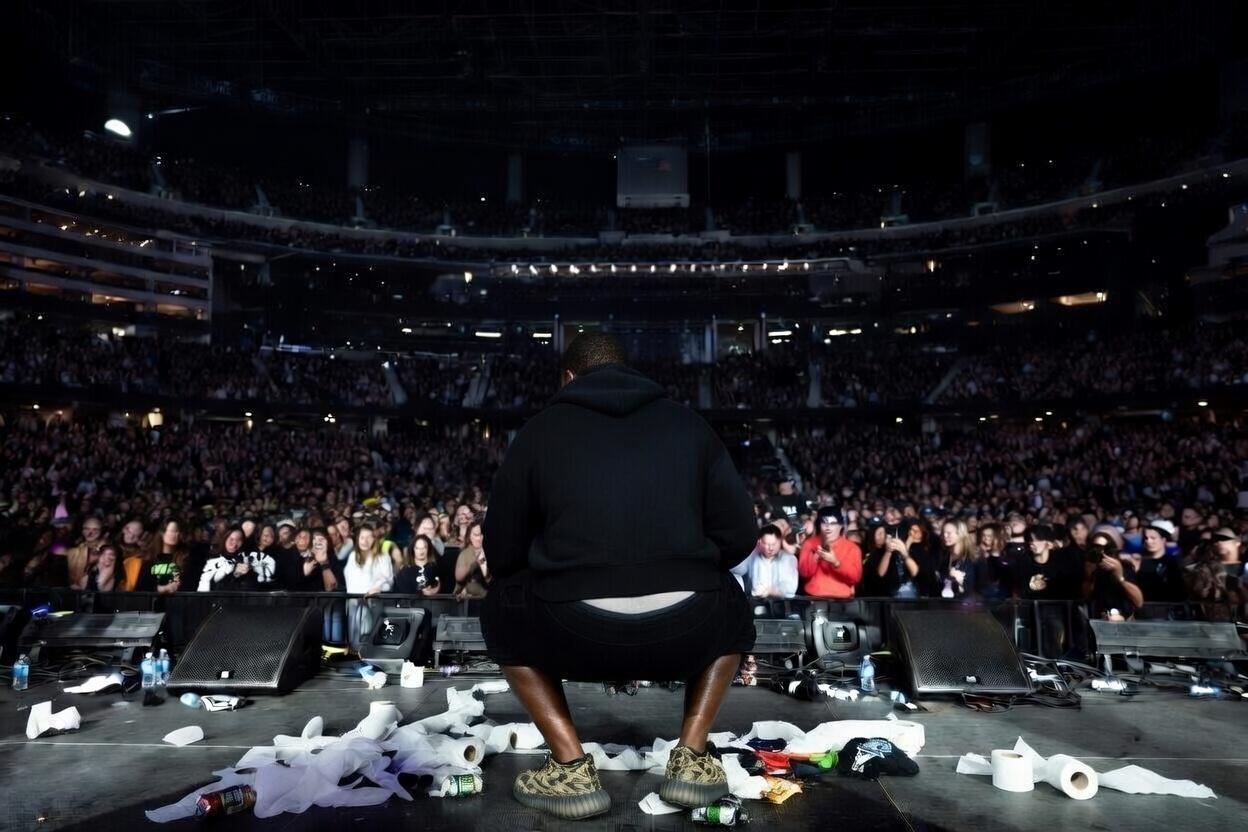
On a cool April night in Inglewood, California, thousands upon thousands of bodies packed SoFi Stadium—that billion-dollar spaceship of a venue—for Kanye West's 2026 comeback. Fresh off dropping his new album Bully on March 28, Ye (as he now insists on being called) hit the stage for his first major U.S. shows in years. The crowd lost their minds. They screamed along to "Jesus Walks" as if the last half-decade of open Nazi admiration, swastika merchandise drops, "Heil Hitler" tracks, Holocaust denial, and relentless cruelty had been a bad dream. They waved their phones during "Stronger," vibing to a Daft Punk sample that Ye had barely touched. They nodded approvingly to whatever half-finished loops he trotted out from Bully—lo-fi, mumble-sung, raw in the way that unfinished work is often mistaken for avant-garde.
Phones up. Vibes high. Nostalgia thick. They acted like the past four years never happened.
It wasn't a concert. It was a clown show. A billion-dollar arena full of willing marks celebrating a man who isn't even talented—just a lazy cut-and-paste merchant with a bottomless hatred for other human beings. And the worst part? They knew. They knew about the swastikas, the Hitler praise, the mockery of George Floyd, the defense of a convicted rapist, the contempt for school shooting victims, the relentless cruelty toward anyone who wasn't him. They knew, and they showed up anyway. Not in spite of it. Because of it. Or at least, not enough in spite of it to stay home.
Let's be brutally honest about the man they came to worship: Kanye West isn't a prodigious talent. He's not a genius. He's not even a particularly skilled musician. What he is—and has always been—is a glorified cut-and-paste artist. A digital collagist who built an empire on the backs of real musicians, real singers, real songwriters, and then had the audacity to call himself a composer. And now, after years of openly praising Adolf Hitler, selling "HH-01" swastika merchandise, terrorizing Jewish communities, mocking George Floyd's death, defending Bill Cosby, calling slavery "a choice," suggesting that COVID-19 was a hoax, attacking the parents of murdered children, and treating every person he encounters as either a pawn or an enemy—after all of that, his fans are still handing over their money. They are still cheering. This isn't forgivable fandom. It's pathetic, willful enabling—of mediocrity wrapped in a philosophy of pure, unvarnished misanthropy.
The Hate Isn't Targeted. It's Total.
Let's be precise about what Kanye has actually said and done, because the media has a habit of sanding down his edges into a more palatable "troubled genius" narrative. The antisemitism is the most famous piece, but it's only one tile in a very large, very ugly mosaic. Kanye didn't just stumble into controversy. He sprinted toward the worst ideas imaginable and planted his flag.
He praised Hitler repeatedly—not once, not twice, but on multiple platforms, with full eye contact and no apparent irony. On a 2022 episode of InfoWars, he stared into the camera and said, "I like Hitler." He followed up by calling himself a Nazi, not as a provocation but as an apparent point of pride. He released a song—a track on one of his Donda era projects—literally titled after the Nazi salute, "Heil Hitler," and reportedly sampled the dictator's own voice from historical recordings. He sold swastika T-shirts coded "HH-01" on his Yeezy website, the "HH" standing for "Heil Hitler," the "01" indicating the first in a planned series. He denied core facts of the Holocaust, claiming that Jewish people "invented" antisemitism to protect themselves. He terrorized Jewish communities with a "death con 3" tweet while antisemitic attacks were already spiking across the United States.
Then came the January 2026 apology. A full-page ad in the Wall Street Journal. Carefully worded, expensively placed. He blamed bipolar disorder, a old car-crash brain injury, and a "four-month manic episode." He said he never meant to hurt anyone. He asked for forgiveness. It was, by the standards of his previous non-apologies, almost professional.
But here's the thing about Kanye West: the pattern is unmistakable. He has walked back his worst statements before, only to double down later when the controversy faded and the attention waned. He apologized to Jewish leaders in 2022 during a private meeting, then went on Alex Jones a week later. He "condemned" antisemitism in a since-deleted Instagram post, then released the swastika shirts. The Wall Street Journal ad may have been expensive, but it was also timed perfectly—just before the Bully release and the SoFi comeback announcement. That's not remorse. That's PR. And anyone who has watched Ye for the last decade knows that when it becomes convenient again, he'll revert. He always does.
But antisemitism is only the headline. The man spreads contempt like confetti, and his hatred has never been limited to one group.
He mocked George Floyd's death. In a 2022 interview, he claimed that Floyd was killed by fentanyl—not by Derek Chauvin's knee on his neck for nine minutes. He suggested that Floyd's girlfriend was lying. He made jokes about it. This is a man who once positioned himself as a voice for Black liberation, who made "George Bush doesn't care about Black people" a national talking point. When it became inconvenient, he threw Floyd under the bus to own the libs.
He called 400 years of slavery "a choice" in a 2018 TMZ interview. Not a metaphor. Not a provocative thought experiment. He stood in a room full of Black staffers and said that centuries of forced bondage, rape, murder, and family separation was essentially a lifestyle decision. When the room recoiled, he doubled down. He said that Black people "stay in slavery because they want to." The phrase "self-hatred" doesn't begin to cover it.
He defended convicted rapist Bill Cosby. He called Cosby "innocent" and claimed that the dozens of women who accused him—women who described being drugged and sexually assaulted over four decades—were part of a conspiracy. This is not antisemitism. This is not even political. This is a man who looks at serial rape and shrugs.
He attacked the parents of school shooting victims. After the Uvalde massacre in 2022, he posted about how the grieving families were "crisis actors." He mocked them. He suggested that mass shootings were staged. He has since half-apologized and then un-apologized multiple times, cycling through the same pattern of cruelty and retraction.
He platformed white nationalists. Nick Fuentes, a known Holocaust denier and white supremacist, dined with Ye at Mar-a-Lago alongside Donald Trump. Ye later pretended not to know who Fuentes was, despite having been photographed with him multiple times and having promoted his content. He has since continued to associate with far-right figures, using them as props in his ongoing performance of transgression.
He bullied employees, ex-wives, collaborators, and his own children when they stopped being useful props. Former Yeezy employees have described a workplace of constant terror, with Ye screaming slurs, firing people on whims, and demanding absolute loyalty. He has publicly harassed Kim Kardashian, his ex-wife, and her then-boyfriend Pete Davidson with gleeful viciousness, posting violent fantasies and mocking Davidson's mental health struggles. He has used his children as props in his feuds, posting their images without consent and dragging them into his public meltdowns.
And beneath all of this is a consistent, throbbing thread: Kanye West does not believe that other people are real. They are obstacles. They are audiences. They are wallets. They are props for his ongoing performance of self-aggrandizement. He does not love his fans—he uses them. He does not love his collaborators—he extracts from them. He does not love his children in any recognizable way—he parades them for photos and then vanishes into the next controversy.
This isn't a guy with "problematic views." This is a solipsistic narcissist who doesn't believe other people are fully real. Everyone else is either a tool for his ego, a wallet for his merch, or an enemy to be crushed. He doesn't hate one group—he hates humanity, with himself as the lone exception. And yes, mental illness plays a role. Bipolar disorder is real, and it can produce manic episodes that lead to reckless and harmful behavior. But millions of people live with bipolar disorder without selling swastikas or mocking dead men. Kanye has had every resource for treatment—the best doctors, the best facilities, unlimited money—and he has consistently refused sustained help, fired his medical team, and surrounded himself with enablers who profit from his chaos. At a certain point, a pattern of hate stops being a symptom and becomes a choice. Kanye made that choice. Repeatedly.
The Sample-Pack Fraud
But let's not let the craft off the hook either. Because the second piece of the SoFi clown show is the musical mediocrity that the crowd pretends is genius. The "genius" everyone keeps simping for? Pure myth.
Kanye's entire career rests on one tired gimmick: dig up an old soul, R&B, or pop record, find a nice four- or eight-bar loop, speed it up or pitch it into that trademark grating chipmunk voice, slap on a basic drum pattern, and rap over it. That's it. That is the formula. No original composition. No complex harmonic arrangements. No understanding of voice leading, counterpoint, or orchestration. No real instrumental skill. Just digital collage work that a competent bedroom producer could replicate in an afternoon with FruityLoops or Ableton Live.
Early albums like The College Dropout got a pass because the samples felt fresh at the time—Luther Vandross, Chaka Khan, The Impressions, Gil Scott-Heron. But even then, he wasn't transforming the source material like a true sampling innovator. Compare Kanye to a genuine genius like J Dilla, who could take a two-second drum break, chop it into sixteenth-note slices, and rearrange them into a polyrhythmic masterpiece that swung like a drunk ghost. Compare him to DJ Shadow, who built "Midnight in a Perfect World" from twelve different interlocking layers of vinyl crackle, live bass re-recording, and pitch-shifted vocals, transforming a single bar of clarinet into something entirely new. Kanye does none of that. He finds a vibe, loops it, and talks over it. He is a curator, not a creator. A music supervisor with a god complex.
Consider the evidence. "Stronger" is just Daft Punk's "Harder, Better, Faster, Stronger" with Ye rapping on top. He didn't produce that beat; Daft Punk did. "Gold Digger" is Ray Charles' "I Got a Woman" (itself a reworking of a gospel song) with a Jamie Foxx impression. "Diamonds from Sierra Leone" is Shirley Bassey's 1970 James Bond theme with a drum machine. "Bound 2" is a Ponderosa Twins Plus One sample, barely altered. Track after track, album after album, the pattern holds: borrow, speed up, claim credit. Even on My Beautiful Dark Twisted Fantasy—his supposed masterpiece—the most celebrated moments ("Power," "All of the Lights," "Runaway") rely on samples, interpolations, and uncredited co-producers like Mike Dean, Jeff Bhasker, and RZA. The man has spent two decades standing on the shoulders of giants and demanding that we call him tall.
And Bully, the album that dropped on March 28, 2026, just days before the SoFi shows? From the phone recordings flooding social media and the official tracks streaming on DSPs, it's more of the same. One track features what sounds like a looped Japanese city pop record from 1982, unchanged except for a sub-bass layer and Ye's mumbling Auto-Tuned hook. Another is built around a pitched-down gospel choir sample he's used twice before on previous albums. There's a track that's just a sped-up Chic guitar riff with no additional instrumentation. No evolution. No growth. No attempt to learn an instrument, read a score, write an original melody, or collaborate as an equal with real musicians. At 48 years old, after two decades in the industry, after unlimited access to the best studios, engineers, and players on earth, Kanye West still makes music like a teenager who just discovered sampling and never bothered to learn anything else.
Real talent writes its own chords. Real talent plays its own parts. Real talent composes its own harmonies, bleeds its own experiences onto the page, and builds something from nothing. Jon Batiste. Esperanza Spalding. Moses Sumney. Little Simz. These are artists who don't need to borrow Ray Charles because they are the Ray Charles of their own generation. Kanye curates other people's greatness, slaps his name on it, and calls it innovation. He's not a producer. He's a cut-and-paste merchant with delusions of godhood.
The SoFi Sellouts and Their Pathetic Excuses
Which brings us back to the 70,000-plus people who packed SoFi Stadium on that April night (and the millions more streaming Bully from home). Because they are not innocent bystanders. They are not just "fans who like the music." They are active participants in the farce. They paid—some of them hundreds, even thousands of dollars—for the privilege of watching a man who praised Hitler, mocked George Floyd, defended a rapist, called slavery a choice, and sold swastikas perform songs built from other people's stolen work. In a city with the second-largest Jewish population in the United States. In a city that erupted in protest after George Floyd's murder. In a city that claims to stand for inclusion, diversity, and basic human decency.
Let's run through the excuses, shall we? Because they are as weak as Ye's drum programming.
"But the music hits different!"
No. It hits different because it's built on the stolen soul of actual talented artists—Shirley Bassey, Ray Charles, Otis Redding, King Crimson, Nina Simone, Daft Punk, and a hundred others who never saw a dime of Kanye's publishing. You're not praising his creativity. You're cheering recycled nostalgia with a side of swastika energy. The music "hits" because someone else wrote it, performed it, and bled for it. Kanye just pressed record.
"Separate the art from the artist."
A noble concept in theory. In practice, it becomes a coward's charter. You can separate Wagner's operas from his antisemitism because Wagner is dead and his music doesn't fund modern hate movements. Kanye is alive, active, and explicitly using his platform to promote a worldview that devalues human life. Every stream, every ticket sale, every cheer at SoFi puts money in his pocket and legitimacy in his mouth. More importantly: when the "art" in question is mostly other people's art—minimally tweaked by a guy who hates humanity—the separation becomes impossible. You're not appreciating a unique creative vision. You're cosigning a theft ring run by a misanthrope.
"He's a visionary! A genius!"
Visionary at what? Finding loops on the internet and speed-ramping them? Genius at self-mythology? Please. Real visionaries innovate. Brian Eno invented ambient music. Björk built her own instruments. Prince played twenty-seven different instruments on his first album. Kanye iterates on cut-and-paste until the well runs dry, then pivots to controversy for relevance. That's not vision. That's survival instinct.
"It's mental health."
Bipolar disorder is real, and it deserves compassion. But millions of people live with bipolar disorder without selling swastikas or mocking dead men. Kanye has had every resource for treatment—unlimited money, the best doctors, the best facilities—and he has consistently refused sustained help, fired his medical team, and surrounded himself with enablers who profit from his chaos. At a certain point, a pattern of hate stops being a symptom and becomes a choice. The SoFi crowd knows this. They just don't care.
"He apologized! He took out a full-page ad in the Wall Street Journal!"
Yeah, in a pricey newspaper ad after the damage was done and the comeback tour was already booked. Apologies mean nothing without changed behavior. Where are the donations to anti-hate organizations? Where are the meetings with Jewish community leaders? Where is the public destruction of the swastika merchandise? Where is the sustained treatment? The timing screams PR cleanup, not genuine remorse. And given his history of apologizing and then relapsing into worse behavior, the smart money says he'll be praising Hitler again by 2027.
"He's just trolling / it's performance art!"
Trolling is a teenager posting a slur on Twitter for attention. Trolling is not a 48-year-old billionaire designing swastika merchandise, selling it on his website, and releasing a song that samples Hitler's voice. At a certain scale, "trolling" becomes "terrorism." The distinction is impact. And Ye's impact has been a measurable increase in antisemitic incidents, harassment of Jewish communities, and the mainstreaming of neo-Nazi imagery. If that's a joke, it's not funny. If it's performance art, it's not art. It's hate.
These fans made a calculation: my nostalgia and entertainment matter more than standing against someone who glorified genocide, mocked murder victims, defended a rapist, and treats every other human as disposable. In Los Angeles—of all places, with its huge Jewish community and its post-George Floyd reckoning—this is especially vile. The SoFi crowd didn't just ignore the hate. They validated it. Every cheer said: You are right. The world is wrong. We are here for you, not for them.
History Won't Be Kind
The SoFi crowd will post their blurry videos on Instagram with captions like "He's back!!!" They'll tell themselves it was "just music" or "just vibes" or "just a concert." They'll say they don't condone the hate, they just wanted to hear "Runaway" live one more time. Deep down, they know better. You don't cheer for a man who praises Hitler and then claim moral neutrality. You don't fund a misanthrope's comeback tour and then pretend you're apolitical. You made a choice. The choice was: my entertainment matters more than your humanity.
History will remember this moment. Not as a triumphant return—not as a genius reclaimed from the wilderness. History will remember the SoFi Stadium Clown Show as a low point. A night when tens of thousands of people decided that recycled beats and borrowed soul were worth more than basic human decency. A night when Los Angeles—a city that knows the cost of hate, a city built by refugees and dreamers and survivors—looked the other way. A night when the crowd cheered not just for a bigot, but for a man who has made it abundantly clear that he does not see them as people either. He sees them as revenue streams. And they thanked him for it.
You didn't support talent. You supported a talentless sampler who built his career on other people's work and then used his platform to spew total contempt for humanity. The beats were borrowed. The genius was marketing. The hate was real. You cheered anyway.
Congratulations. You got your nostalgia fix. You got your grainy concert videos. You got to feel something for a few hours. You also proved that for enough spectacle and old hits, plenty of people will happily dance beside evil and pretend it's harmless fun.
It wasn't harmless. It wasn't deep. And your defense isn't either.
The SoFi Stadium Clown Show wasn't a redemption arc. It was a mirror—and the reflection is ugly.


 English
 Arabic
 French
 Spanish
 Portuguese
 Deutsch
 Turkish
 Italiano
 Russian
 Romaian
 Portuguese (Brazil)
 Greek
Greek